


Do the cracks in your asphalt parking lot or road have water seeping out of them no matter what you do? There’s most likely water pooling underneath the pavement, breaking it down. It’s not uncommon to see french drains in St. Louis as a way to protect your pavement from water-related damage.
Removing that water through a french drain can help slow the deterioration of your pavement over time and reduce the need for urgent maintenance. But what is a french drain and how does it work?
What Is a French Drain?
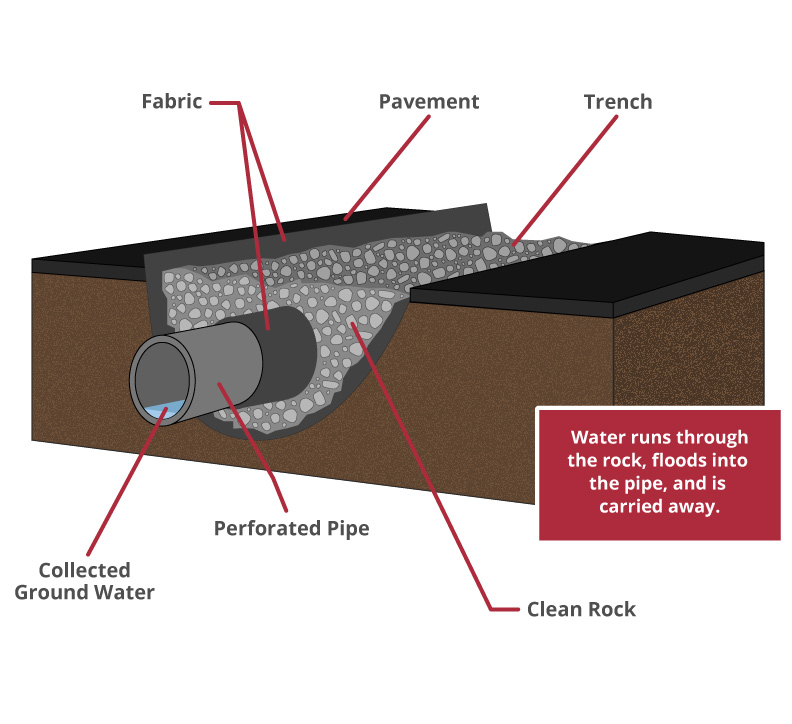
A french drain is a perforated pipe surrounded by clean rock that’s installed underneath the pavement to prevent unwanted water from collecting by channeling it into a nearby ditch, catch basin or storm sewer.
How do french drains in St. Louis work?
To install french drains in St. Louis, we cut a trench about eight inches wide and two feet deep at predetermined locations and line the bottom of the trench with clean rock. The perforated pipe is placed in the trench and covered in a filtering sock to keep out debris and prevent clogging. Once the trench is filled and compacted with clean rock, it’s paved over with asphalt or concrete to match the surrounding surface.
Now, instead of pooling under the pavement, water drops through the perforations in the pipe and is carried out from under the pavement to be deposited into a collection basin or sewer.
Is It Actually French?
Contrary to popular belief, the french drain was not named for the country, but rather for Henry Flagg French, who introduced the drainage system in his 1859 book, Farm Drainage. Useful beyond its agricultural roots, the french drain is now commonly used to prevent water damage to the foundations of pavement, homes and businesses all around St. Louis.
Why Is Water so Harmful to Pavement?
Aside from the stormwater that accumulates from heavy rains and snow, water can come from a variety of different sources to compromise pavement. In St. Louis, many areas have natural springs that are uncovered during construction. Irrigation systems also contribute to a lot of the groundwater in the area.
When water collects under pavement, whether asphalt or concrete, it begins to break down the foundation, making it soft and viable for damage. As cars drive over the area, the broken down foundation won’t be able to handle the pressure. It gives, forming dips in the pavement that crack and allow the water to seep out. In the winter, that freezing water can also expand, causing the pavement to lift up and creating additional cracks in the process.
Once there are cracks, more water is able to get through and pool under the pavement. The additional water widens the cracks, and the situation snowballs from there. For these kinds of water damage, you’ll likely need repair work along with the french drain.
Need a French Drain in St. Louis?
If you’ve noticed some of the telltale signs of water damage underneath your pavement, our team at Ford Asphalt Company would be happy to assess your situation and discuss installing a french drain, as well as other necessary repairs. We provide a wide variety of asphalt and concrete repair services. Contact us to get an estimate for your property.
 Connect on LinkedIn
 Connect on Facebook